

This is the most competitive but prestigious route. Publishers pay out of their own pockets for your book’s publication because they see it as a worthy investment; in return, they will request the rights to your work in exchange for (at most) 10 percent of the royalties.
What makes it competitive is that there aren’t many slots offered to new authors, especially if you don’t have a strong writing background or publication history behind you. What makes it prestigious is essentially the exact same thing—its selectivity.
How It Works
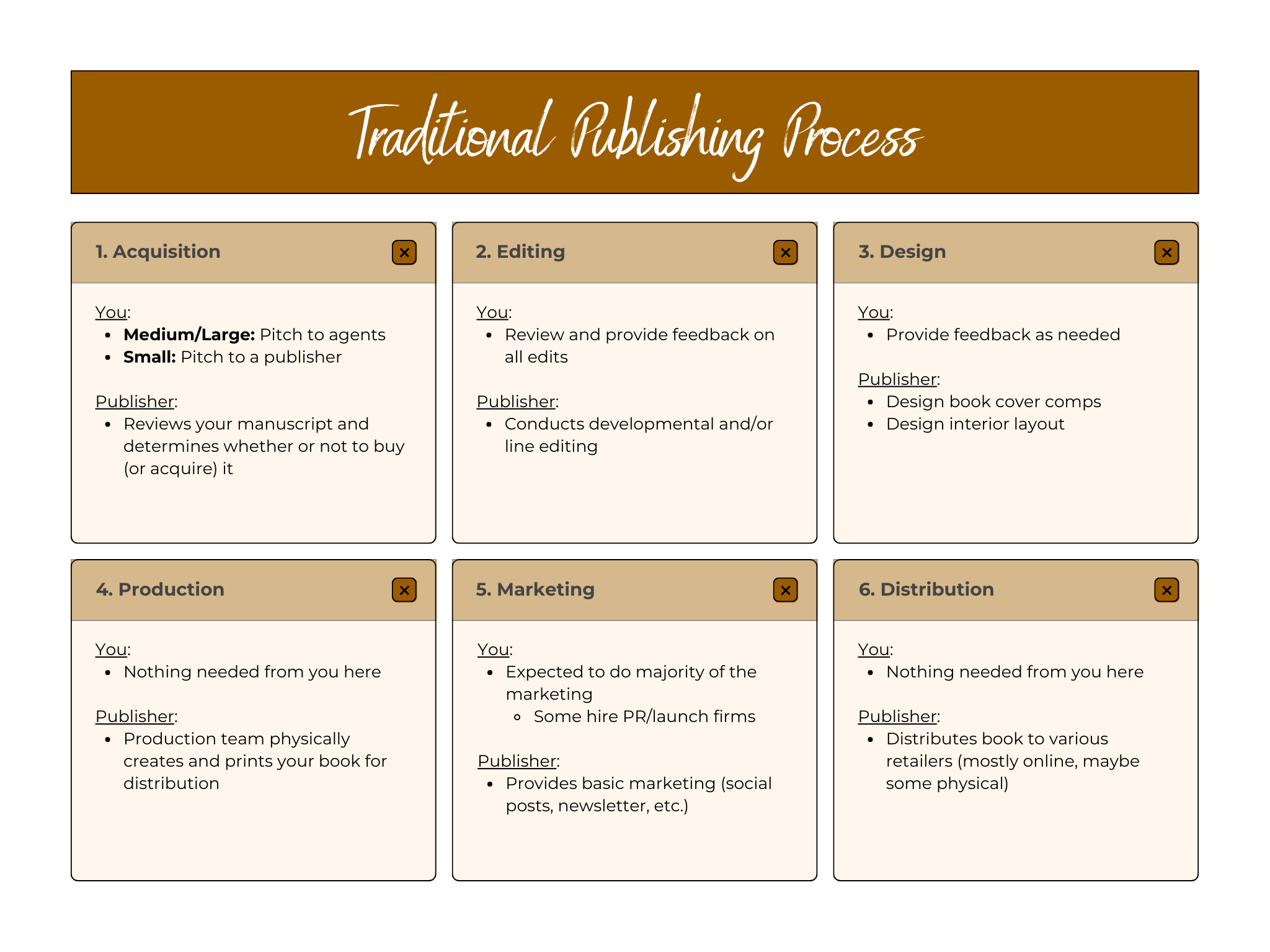
Who The Publishers Are
Traditional publishing is a big umbrella term that covers three differently sized presses: large (the “Big 5”), medium, and small.
- Large Presses (“Big 5”)
- The “Big 5” are the largest, most prestigious publishing houses in the United States, all residing in New York City: Penguin Random House, HarperCollins, Hachette, Simon & Schuster, and Macmillan. If these publishers are the tree trunks, their divisions are the branches and their imprints are the twigs. Here’s a great, interactive visual for this.
- The “Big 5” are the largest, most prestigious publishing houses in the United States, all residing in New York City: Penguin Random House, HarperCollins, Hachette, Simon & Schuster, and Macmillan. If these publishers are the tree trunks, their divisions are the branches and their imprints are the twigs. Here’s a great, interactive visual for this.
- Medium Presses
- These houses aren’t as large as the “Big 5”, but they’re still pretty well known. These include Houghton Mifflin Harcourt, Scholastic, Workman, Sourcebooks, Wiley & Sons, W.W. Norton, Kensington, Chronicle, Tyndale, and some university presses (e.g. University of Chicago Press).
- These publishers basically work the same as the larger ones, operating from similar or identical business models (see the above graphic).
- These houses aren’t as large as the “Big 5”, but they’re still pretty well known. These include Houghton Mifflin Harcourt, Scholastic, Workman, Sourcebooks, Wiley & Sons, W.W. Norton, Kensington, Chronicle, Tyndale, and some university presses (e.g. University of Chicago Press).
- Small Presses
- These follow the same or similar processes as the other publishers as far as the editing, production, and distribution process, the only difference is majority of them do not offer brick-and-mortar placements.
- Smaller presses tend to work in more idiosyncratic ways and are often seen as being more open to lesser-known authors with smaller platforms and riskier pieces.
- These follow the same or similar processes as the other publishers as far as the editing, production, and distribution process, the only difference is majority of them do not offer brick-and-mortar placements.
Pros & Cons
I think it’s important to summarize traditional publishing by outlining what its benefits and disadvantages are, so I’ve listed these below:
PROS
➕ It’s Free: The cost of publication is fully covered by your publisher in exchange for your book’s rights (in return you get 10% of the royalties, at most).
➕ Expert Team: You get an experienced team of editors, designers, and other industry experts to support your publication process.
➕ Credibility & Prestige: You become a part of the 1-2%, can leverage the name of your publisher (especially beneficial to nonfiction authors), and you’ve gained new industry connections.
➕ Physical Distribution: Your book is most likely to make it into brick-and-mortar stores, like Barnes & Noble and independent bookshops.
CONS
➖ Minimal Rights: In exchange for traditional publication, you are transferring—or selling—your work’s ownership from you to the publisher.
➖ Lower Royalties: At most, traditionally published authors will receive 10% of their book’s royalties; for example, if you’re book is $10, you would get $1.
➖ Large Time Investment: Writing your book, editing it, finding an agent, and the publishing process itself can take years due to the volume of submissions and the size of the publisher (especially if it’s one of the Big 5).
➖ Lots of Rejection: As you begin to pitch to agents and/or small presses, you can expect to face a lot of rejections and/or radio silence.
Other Resources
I would highly recommend checking out this Publishing Pathway Overview created by the amazing Jane Friedman . She does such a phenomenal job of outlining a lot of the nitty-gritty, good-to-know info that encapsulates the massive umbrella of traditional publishing. She also updates this graphic yearly.
⭐ Let’s keep the conversation going! Email me at lauren@laurenericksonofficial.com ⭐
If you found this information useful, consider subscribing to this newsletter. Otherwise, feel free to check out my YouTube channel or follow me on Instagram!


