

1. “Inspect” Your Book Idea
I can’t tell you how to get a book idea, but I can tell you what to do after you’ve gotten one. You’ll want to analyze your idea from a few different angles to make sure it’s worth the work and energy you’ll be putting into it. The last thing you’d want to have happen is pour your heart and soul into a brand new book, only to hear agents or editors tell you they don’t see much of a market for it.
To help prevent this, I’m going to ask you four questions about your book idea:
- What’s your long-term vision? (Personally or professionally)
- What are your short-term goals? (Personally or professionally)
- How would this book support those things?
- What market(s) do/does your book belong to?
The last question has to do with something called “comp titles” (short for comparable titles). Basically, this is where you compare your book idea with other similar books/authors that have ideally been published within the last five years or so. You’ll be looking at the authors’ backgrounds, customer reviews, and any trade reviews (reviews by magazines like Kirkus, PublishersWeekly, and LibraryJournal) to determine how “successful” it was.
Usually you’d do this a bit later when you start “pitching” your idea, but my advice is to do this early on so you can show agents/editors and yourself that there is a need and want for your book. Like I said, the last thing you’d want to do is write a book that no one asked for (or is interested in).
2. Review Your Publishing Options
I know we’re focusing on the traditional route with this blog, but I want to make sure you understand your options, as well as their various pros and cons.
- Traditional
- This is where a team of in-house professionals publish the book for you
- PROS (Graphic): It’s free of charge, you get a team of industry experts, offers credibility/prestige, and you have a higher chance of physical distribution (ex: placements in Barnes & Noble)
- CONS (Graphic): You’re selling your book’s rights, in exchange you get royalties (10% max), it’s a large time investment (can take ~1-2 years to publish), and you are more likely to face lots of rejection from agents and editors
- This is where a team of in-house professionals publish the book for you
- Self (or Indie)
- This is where you publish the book yourself and are responsible for all the moving pieces
- PROS (Graphic): Total creative freedom, highest profit margin, fastest timeline to publication, retain 100% of the rights to your work
- CONS (Graphic): Large time and money investment, full responsibility, hardly any physical distribution, minimal trade reviews from magazines (like Kirkus, PublishersWeekly, LibraryJournal, etc.)
- This is where you publish the book yourself and are responsible for all the moving pieces
- Hybrid
- This is a “pay-to-publish” blend of the two where you pay a small team to publish your book but still have creative flexibility and majority of the royalties
- PROS (Graphic): More creative flexibility, higher profit margin (not as much as self but still majority), faster timeline, retain all rights
- CONS (Graphic): Higher up-front cost, at risk of getting looped in with vanity presses (less ethical presses who charge a lot for the bare minimum), risk minimal ROI on your financial investment, would require extra research to find the right press for you
- This is a “pay-to-publish” blend of the two where you pay a small team to publish your book but still have creative flexibility and majority of the royalties
3. Understand the Traditional Publishing Process
When we’re talking about traditional publishing, we’re talking about a pretty big umbrella that covers houses of varying sizes: small, medium, and the “Big 5” (large).
Generally, the bigger the publishing house, the more you’ll need an agent to represent you as many mid-size and large presses don’t accept “unsolicited manuscripts”, or un-agented books. Small presses don’t always require an agent, so you might be able to get away without having one if you decide, later on, you don’t want to go that route.
Agents generally help with the following:
- Contracts (book deals)
- Negotiations
- Rights/sub-rights
- Project management
- Editorial work
- Networking
- Pitching to editors
They’re on your side. They want what’s best for you and your book because, simply put, if you don’t get paid, they don’t get paid. So naturally, they’re gonna do their best to get the best deal for you both since you’re a team. Agents also act as the “middle-men” between you and the publishers, so communication will often come from them as well.
**TO LEARN MORE ABOUT AGENTS, READ THIS POST**
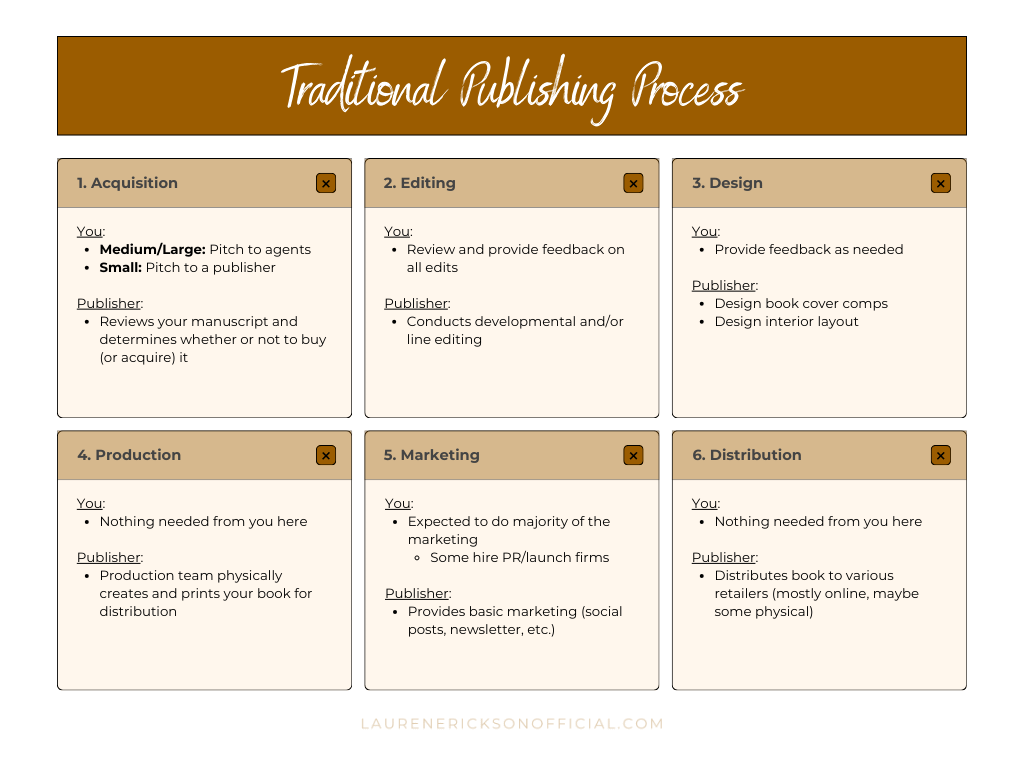
Above is a visual outline of how the traditional publishing process works. Click to enlarge it and you’ll see that it goes Acquisition > Editing > Design > Production > Marketing > Distribution.
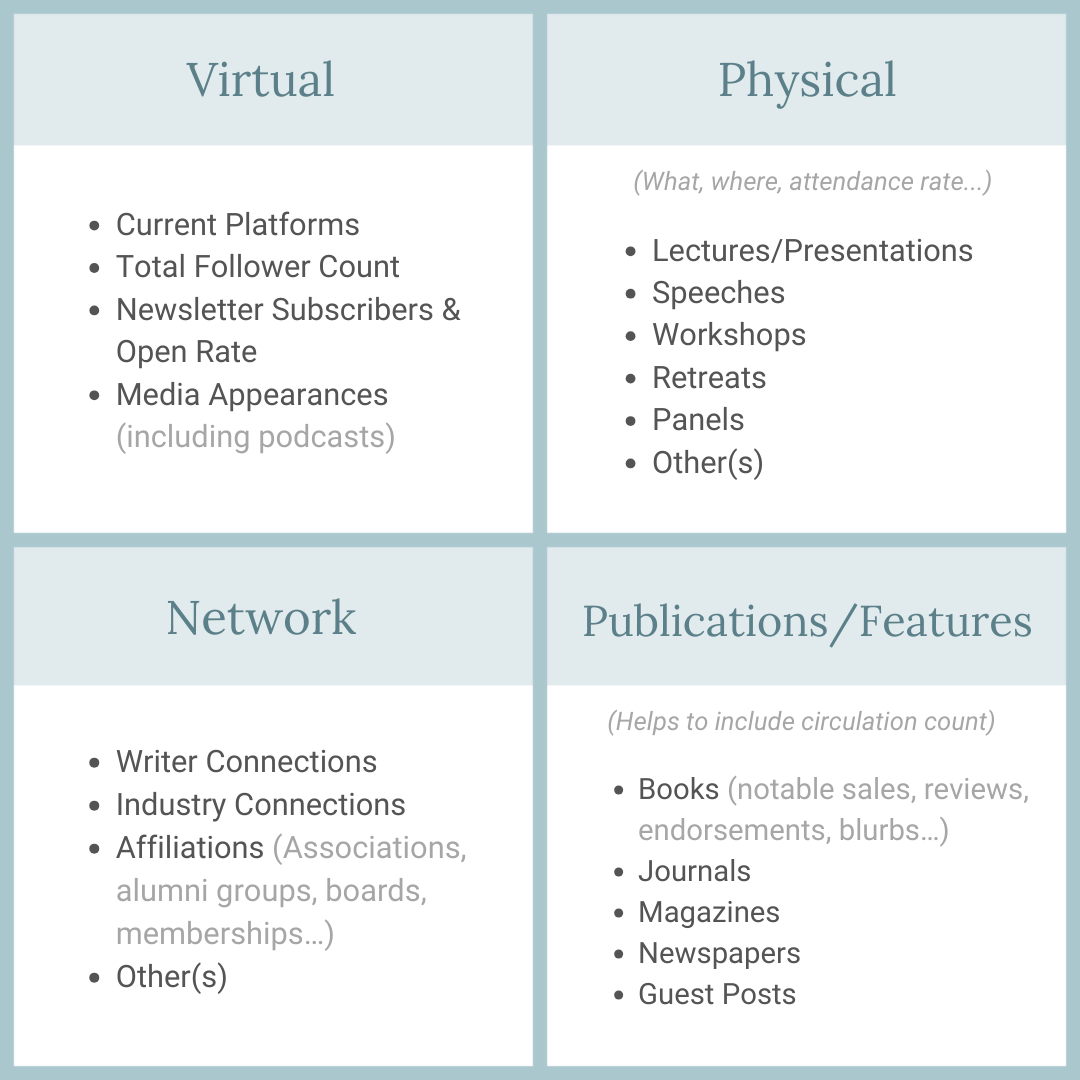
What’s important to understand is how YOU fit into the process. Further, it’s worth considering what you have to offer to your publisher. This isn’t how it used to be 40-50 years ago; you’d only be responsible for writing the book. Now, because of our extremely digital age, everyone’s marketing everything on social media – so what can you do (or what leverage do you have) to sell multiple copies of your book? The bigger the publisher, the bigger the demand.
But the thing is, platform doesn’t have to be all digital. A lot of it is just about influence, so consider where you stand with each of these:
4. Write & Edit the Book
You’ll be spending a lot of time here. The writing process for fiction and nonfiction will differ greatly. Memoir is kind of in a funky category because it’s nonfiction, but it’s heavily narrative – so for the purpose of this blog, I’m lumping it in with fiction.
For Fiction / Memoir
- I would highly recommend checking out my free “Write a Bestselling Book” Course; it’s on my website and outlines exactly how to both write, edit, and prep your book for publication.
- This part will include outlining, routine-setting, and just…writing (sometimes, it’s just as easy and just as difficult as that)
For Nonfiction
- You’ll be creating something called a “Book Proposal”, which is essentially a business plan for your book; it’s easily 20-30 pages long.
- You’re not actually writing the book, but you are outlining the book’s overview, its market, its target audience, marketing and promotion efforts, sample chapters, and a few more things.
- Coming Soon! My goal is to finish a free Book Proposal Masterclass for you by the end of this month (January 2024) so you can get more in-depth guidance on how to write one; it also includes a template. Stay tuned for that!
5. Prep Submission Materials
These are the materials you’ll be sending to agents and/or editors for either representation and/or publication. Again, if you’re going for a mid-size or large (“Big 5”) press, you’ll most likely need an agent. For small presses, you typically don’t but it never hurts to double check.
For Fiction / Memoir
You’ll need to have your full manuscript written even if you’re submitting sample chapters because if you get a request for the full document, you’ll need to be able to produce it.
- Query Letter (it’s like a cover letter for your book)
- Synopsis (an overview of your book)
- 3-5 Sample Chapters (depending on length)
- Elevator Pitch (“My book is about…”)
For Nonfiction
You’ll pitch your proposal to agents/publishers and, once you get a contract, you’ll be allotted a certain amount of time to write the book. Sometimes you’re even given advances to write the book, depending on the publisher’s size/budget.
You’ll need…
- Your Book Proposal
- Query Letter (a condensed version of your proposal)
- Elevator Pitch (“My book is about…”)
Your goal with this pursuit is going to look like…
- If Seeking Agent: Getting a full manuscript request; if they like it, you’ll sign with them, they’ll start pitching it to editors/publishers, and THEN you’ll (hopefully) get a book deal
- If Seeking Small Presses: Getting a response; if they like it, they’ll offer you a book deal which you’ll want to review and sign if you like them (Authors Guild has legal services for reviewing contracts).
To see how ready your manuscript is for publication, I suggest reviewing “The Top 10 Questions EVERY Aspiring Author Should Be Able to Answer”.
6. Pitch to Agents/Publishers
Getting an agent by itself can take years. So I would highly encourage you to start off by asking around to see if you know anyone who’s connected. This could dramatically reduce your time investment.
If you don’t have industry connections, be prepared to treat your pitching like a part-time job until you can get representation. It ultimately depends on how much value you’re placing on your book and/or traditional publishing path. If you don’t think it’s worth it, don’t do it. If you think it is, get ready to play the long game.
Each agent and publisher is going to have their own submission criteria listed on their website (usually under the “Submissions” tab). Please read these CAREFULLY as your manuscript/proposal will not be considered if you don’t follow them to a tee.
**To learn more about the pitching process and where to look for agents, check out this post: Where to Find Literary Agents**
7. Negotiations/Contracts
Once you get an agent (if you’re going that route), they’ll start pitching your book to acquisitions editors on your behalf in hopes of scoring a book deal. Once this happens, everyone sits down and starts negotiating their contracts. This is why it can be beneficial to have an agent—their the expert and they know what the best deal is for you and your manuscript.
If you’re going un-agented, you’ll be responsible for reading, understanding, and signing the book contract yourself. Like I said, if this makes you nervous, consider joining the Authors Guild and utilizing their legal services; they have lawyers available to review traditional publishing contracts.
8. Publishing Process Begins
Once you’re in with a publisher, this is the process you can expect to follow:
Editing > Design > Production > Marketing & Distribution
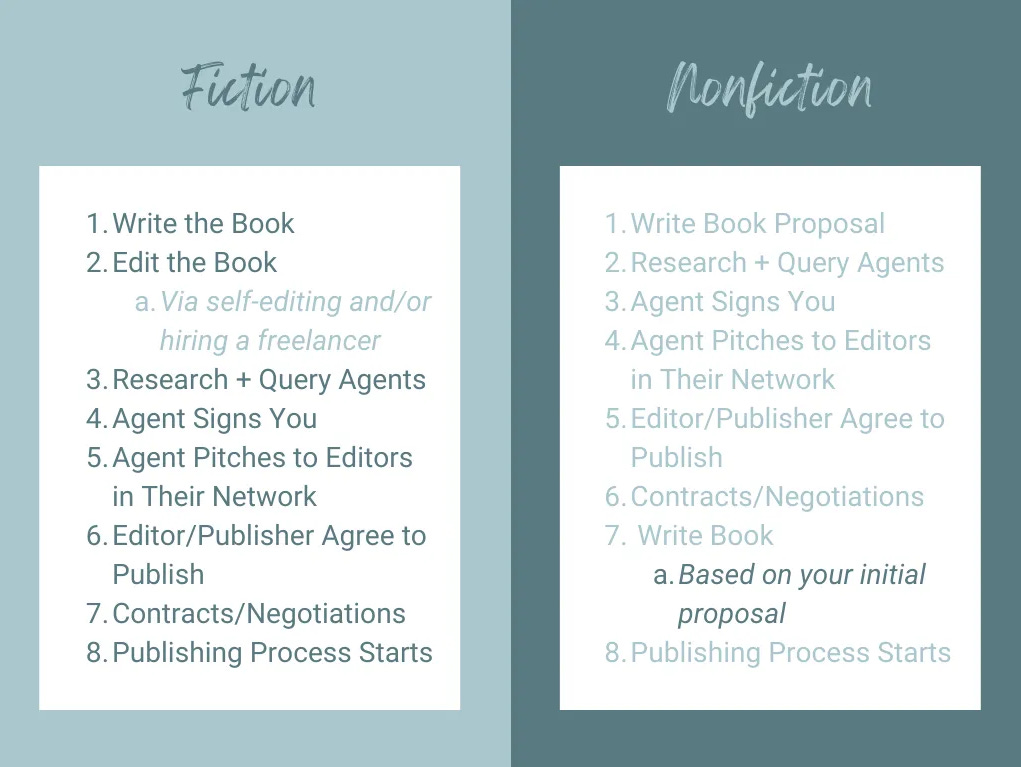
You can also take a look at this graphic below to get a birds-eye view of everything we’ve discussed up until this point.
9. Leverage Your Book & Authorship
Congrats, you did it! Your book’s publication is the beginning of its new life; take time to revisit your goals and vision from Step 1 and make sure your book is still in alignment with it.
From here, continue marketing and promoting both your book AND yourself as a new (bestselling) author; leverage these accolades to get more opportunities, like speaking, mentoring, podcasts, hosting events, webinars, workshops, getting on panels, you name it.
**To learn more about this piece, feel free to check out my blog, How to Launch Your First Book.**
⭐ Let’s keep the conversation going! Email me at lauren@laurenericksonofficial.com ⭐
If you found this information useful, consider subscribing to this newsletter. Otherwise, feel free to check out my YouTube channel or follow me on Instagram!


